Linneus began with one man, one horse, and a cabin in the woods — and grew into the seat of justice for all of Linn County.
A Cabin in the Timber, 1834
The first settler on the site of Linneus was Colonel John Holland, who came from Virginia in the early spring of 1834 and laid his claim on the land where the county seat now stands. He had first wandered into the "Locust Creek country" around 1832 while exploring on horseback, got badly lost for three days with no food or shelter, and was finally carried to safety by his faithful horse, Hector, who found his way to a settler's cabin.
Holland's cabin was built of hewed logs and had two rooms. It became the heart of the new settlement — court was held there, school was taught there, and a great deal of public business was transacted under its roof. It stood near the center of what is today the public square. Heavy timber surrounded it for years, and the early residents were often lulled to sleep by the howling of wolves and the hooting of owls.
The Colonel once told that at the very first breakfast eaten in this cabin, the main dish was a brace of stewed squirrels — which he shot from the trees around his door while standing on his own doorstep.
An act of quiet heroism marked those first days, too. While Holland's hired man dug a well, he was overcome by gas at the bottom. Holland climbed down to tie a rope to him and was overcome himself. His wife, Elizabeth — "a slight woman, commonly not of much strength" — drew her husband up out of the well by hand, screamed for a passing settler, and together they saved both lives. It was, the old history says, one more name added to the long list of heroic deeds by the pioneer women of Missouri.
The County Seat, 1837–1853
Linneus was established as the seat of justice for Linn County around 1837, and the little village in the woods began to grow in earnest. Speculators and home-seekers bought lots; log houses gave way to the first frame buildings. On February 9, 1853, the County Court granted the petition of the townspeople and formally incorporated the town of Linneus, appointing John G. Flournoy, Edward Hoyle, Alexander Carroll, Marshall Harrison, and William M. Long as its first trustees.
The first frame building in town was put up by a tailor named Gibbs in 1840, just north of the public square — its lumber cut by hand with an old-fashioned whip-saw, there being no sawmill anywhere nearby. The first child born in the settlement was John T. Flournoy, on May 5, 1837, near the northwest corner of the square; the first girl was Mildred "Milly" Holland, born January 17, 1839.
God's Acre
Colonel Holland donated an acre of land to the town for a cemetery — the same one still in use today. The story of its first burial is a town favorite: a carpenter and grocer named Timothy Weber once joked that "it would be a good thing now, if somebody would die, so that we could mark that graveyard and give it a good start." Weber himself died not long after, and his was the first body laid to rest there. By 1873 the cemetery had fallen into neglect, its fence down and brambles growing among the graves, until two women — Mrs. Thompson and Mrs. McCormick — passed a subscription paper and raised the funds to restore it.
Schools and Stores
The first school was taught by Benjamin White around 1838, followed by Allen Gillespie and then John G. Flournoy, who held class in the old Holland house. The first public schoolhouse — a frame building eighteen by twenty-two feet, costing about $300 — went up around 1847, with William Sanders, a native of Maine, teaching its first twenty-five pupils.
John G. Ball is generally credited as the town's first merchant, though the honor was disputed even then. Stores were modest affairs: a wagon-load of goods counted as a large stock, and sugar and coffee were the staples. The town's signature early industry was tobacco — David Prewitt, one of Linneus's leading merchants, manufactured plug tobacco here for many years and hauled it by wagon to country stores and as far as southern Iowa.
"Old Bullion" Comes to Town, 1856
In the summer of 1856, Thomas Hart Benton — Missouri's famous thirty-year U.S. senator, nicknamed "Old Bullion" — came to Linneus and spoke to a large crowd from the door of the courthouse while campaigning for governor. He stayed as the guest of Edward Hoyle. It is believed to be the only time the great statesman ever visited the town.
The Railroad Arrives, 1872
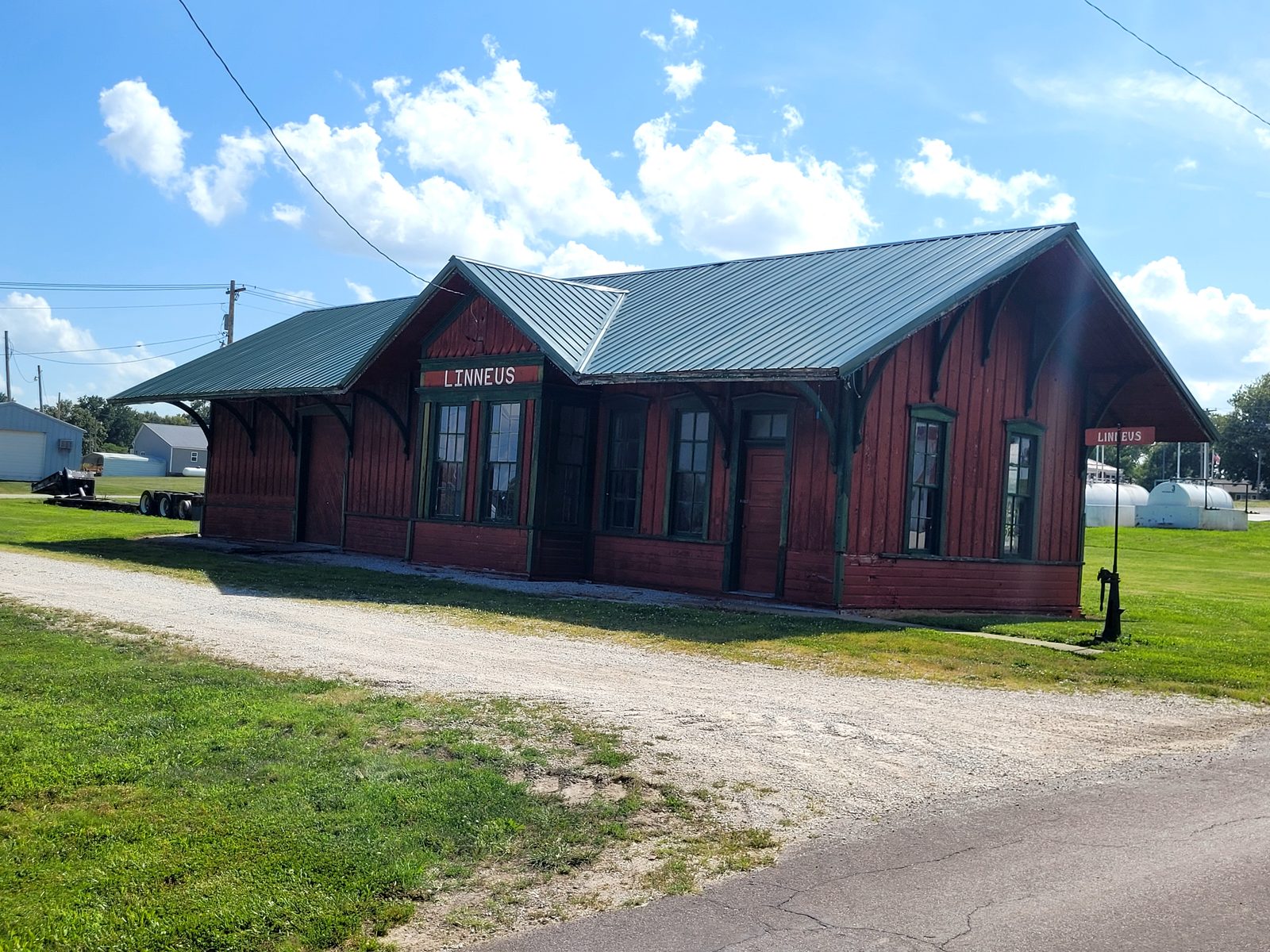
Nothing changed Linneus more than the railroad. After the town and township pledged tens of thousands of dollars toward the line, the first locomotive over the Linneus branch of the Burlington & Southwestern — named the "Col. Northcott" — came through, and on September 1, 1872, the first train rolled into Linneus from Laclede. The gap in the line was closed in 1876, connecting the town to the wider world. From that point on, the history records, "the town began to improve, and has made considerable advancement in its material prosperity."
Fire, and a Castle on the Square
Like most frontier county seats built of wood, Linneus knew fire. A blaze in November 1877 destroyed a restaurant, a hotel, and a saloon on the south side of the square, and in January 1879 a much larger fire on the west side caused some $17,000 in damage, taking out a general store, a brick building housing a hardware store, a lodge room, and the offices of a dentist and a lawyer.
But the town was on the rise. In 1880 a group of citizens formed a stock company and built a substantial two-story brick hotel on the southwest corner of the public square — a building so grand, with its towers, verandas, colonnades, and buttresses, that the old history called it "castle-like" and said it caught the eye of every visitor. It was finished in February 1881.
A Bustling County Seat, 1881
By June 1881, Linneus was a busy place for its size. The town supported a bank, five firms of attorneys, three physicians, three drugstores, three blacksmiths, two hotels, a flouring mill, a newspaper, and dozens of other trades — from jewelers and milliners to harness-makers and a photographer. On March 18, 1880, by a large majority of its citizens' votes, Linneus had been made a city of the fourth class, taking its station "among the other cities of the State." It has carried that official title ever since — a designation that may raise a smile from anyone who lives in our small, friendly town today.
Adapted from the chapter "City of Linneus" in the History of Linn County, Missouri (1882). Spelling and phrasing have been gently modernized for readability. The original is preserved in the project's research archive.
Linneus Timeline
- 1834Colonel John Holland builds his cabin on the future public square.
- 1837Linneus becomes the seat of justice for Linn County.
- 1840The first frame building, a tailor's shop, is raised north of the square.
- 1853The County Court formally incorporates the town of Linneus.
- 1856Senator Thomas Hart Benton speaks from the courthouse door.
- 1872The first train rolls into Linneus on September 1.
- 1879A great fire sweeps the west side of the public square.
- 1880Linneus is incorporated as a city of the fourth class.
- 1881The "castle-like" brick hotel on the square is completed.
More of Our Story — Coming Soon
The early records hold harder chapters too — accounts of slavery and of violence that reflect the times in which they were written. We believe history should be preserved, not erased, so these will be added in a dedicated section with proper historical context and a content note, rather than left out altogether. If you have family records, photos, or stories to contribute, we'd love to hear from you.